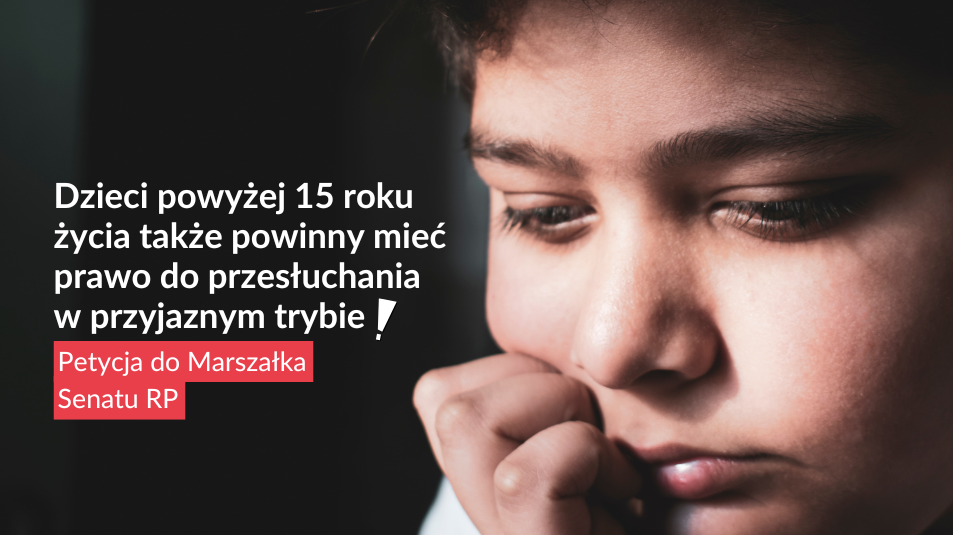
We have prepared a proposal to change the recipe for friendly interrogations with the participation of children. The project involves extending the protective procedure of interrogation to children aggrieved by the crime of sexual abuse or abuse to the 18th – not 15th, as is now – the age of 18. The petition was supported by 26 aid organizations, incl. Association of Family Judges in Poland, National Emergency Service for Victims of Domestic Violence ‘Blue Line’, Committee for the Protection of Children’s Rights, Coalition for Family Foster Care and the Salvation Foundation. This week, the petition will be submitted to the Senate Petitions Committee.
We have a ready draft amendment to Article 185 A, B, C and D of the CCP. In it, he proposes, first of all, to guarantee a protective procedure for interrogating children with a crime up to 18 years of age, the obligation to immediately organize a hearing by the court and to ensure the presence of a probation officer who represents the child’s interests. After the Senate Committee on Human Rights, Rule of Law and Petitions has been considered by the Senate, the draft will be processed in accordance with the provisions of the Petitions Act.
According to the data of the Ministry of Justice, in 2021 there were 33,388 children who were aggrieved with various types of crimes, which, due to their age, were not entitled to a friendly interrogation procedure[1]. This state of affairs needs to be changed, hence the initiative of the Foundation, which aims to amend the regulations and draw public attention to the fact that our judiciary has not yet matured to treat children participating in the procedures with dignity and mindfulness. The FDDS petition was supported by 26 non-governmental organizations and aid institutions. This shows that many specialists dealing with this subject see the need for change – says Renata Szredzińska, member of the FDDS board.
20 years ago, our Foundation initiated an introduction to the Code of Criminal Procedure for the Protection of Children. In our facility in Warsaw, we opened and ran the first friendly interrogation room in Poland. Today, there are about 470 of them throughout the country. We are convinced that all children, including those over 15 years of age, should be treated in a special way by representatives of the justice system. This allows not only to protect them from secondary victimization, but also to obtain testimonies of greater probative value – says Justyna Podlewska, coordinator of the legal department at FDDS.
At the moment, pursuant to Article 185 a, b and d of the Code of Criminal Procedure, a child aggrieved by the crime of sexual abuse or physical or mental abuse and witnessing these crimes has the right to be questioned in a friendly interrogation room by a judge in the presence of an expert psychologist (what are friendly interrogations about can be seen here). This right, however, is granted to not all children, but up to 15 years of age.
The postulates of changing the regulations were prepared by the FDDS, inter alia, under the influence of experiences from the interdisciplinary cooperation of psychologists, psychiatrists, therapists and lawyers in the Foundation’s Aid Centers for Children. The Foundation demands that the right to the protective procedure of interrogations should be granted to aggrieved children until they reach the age of majority.
It is definitely not the case that the statutory 15-year limit is the moment after which the child becomes more stress-resistant, a person who can be treated in the same way during court procedures as an adult. We have 16- and 17-year-olds under our care, for whom we tried to obtain permission to be questioned in a friendly room, but our conclusions were rejected by the court and these people had to testify in the courtroom or in the police station. They were interrogated by untrained workers who have insufficient awareness of the emotionality of the child after experiencing harm. After such interrogations, the symptoms of trauma often worsen, children return to self-harm, for example. In conversations with us, they emphasize that it was a very difficult experience for them. Restarting therapeutic work is then much more difficult. Unfortunately, there are also situations where young people attempt suicide because participation in procedures is too burdensome for them – says Joanna Klocek, therapist for the Children’s Help Center in Warsaw.
In its proposal to amend the provision 185 and the Code of Criminal Procedure, the Foundation added to the persons entitled to participate in the hearing of the probation officer, i.e. the representative of the minor victim’s rights, in a situation where the parent is suspected of making crimes to his detriment. The current provision does not mention the probation officer, which means that in practice during the interrogation no one represents the child often. This should by no means take place, as the hearing is often crucial for formulating the indictment, and then the conviction of the perpetrator.
Another change proposed by the FDDS concerns the date of the hearing. According to the current law, it must take place ‘immediately, not later than within 14 days from the date of receipt of the application’ from the prosecutor.
The Foundation calls for resignation from the period of 14 days, and leaving the term ‘immediately’ in the provision. Currently, this term, although instructive, is treated by the courts as an obligation and hearings are automatically determined within 14 days of receipt of the application. The Foundation’s experience shows that this deadline does not provide protection, and causes the hearings to take place too early, without establishing the circumstances of the act, and result in the need to re-hear the child due to the appearance of new circumstances and evidence in the case. This causes the secondary victimization of the minor victim – says Justyna Podlewska.
***
The content of the petition is available in the document below.
The petition is one of the elements of the ‘Child-Friendly Justice’ program implemented by the Foundation, implemented from the Active Citizens Program – a national fund funded by Iceland, Liechtenstein and Norway under the EEA funds.
The full list of organizations that supported the petition: the Association of Family Judges in Poland, the ‘Blue Line’ Emergency Service of the IPZ, the Committee for the Protection of Children’s Rights, the Coalition for Family Foster Care, the Salvation Foundation, the Second Foundation, the ‘Hope Family’ Association The Polish Women Foundation, the ‘Child w Centrum’ Foundation, Halina Nieć Legal Aid Center, Ukrainian House in Warsaw Foundation Nasz Wysice, Feniks Foundation for Violence, Youth Aid Society, Mutual Aid Association Be Together, Association Mudita, the Evangelization and Charity Association ‘Mocni w Duchu’, Specialist Daily Support Center in Radłów and its governing body, the Association for Counteracting the Phenomenon of Social Pathology AMOS, the Arka Association, the Iskierka Aid Association, the Power Support Association, the Commune Center Social Welfare in Bogdaniec, Dom Therapy Foundation, Baba Lubuskie Association for Women, Elephant Foundation on the balcony, Municipal and Communal Social Welfare Center in Tyczyn and Edukabe Foundation for Creative Solutions.
[1] Statistics of the Ministry of Justice, https://isws.ms.gov.pl/pl/baza-statystyczna/oprawania-wieloleniczne/